
Letter to Voltaire

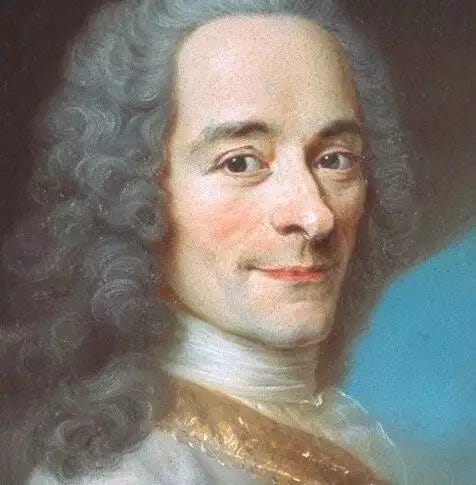
Monsieur Voltaire,
I wish to thank you for entrusting me with providing a religious man’s perspective on your manuscript. Regardless of our serious disagreements on matters of God and faith, I have found myself greatly edified by your wit and piercing insight!
Without mincing words, you have expressed your wish to make fools out of us churchmen, and this book is perhaps intended to be a satire at our expense. You have said, both publicly and in private, that there is no way in which one can trust in the benevolence of God when the world is flooded with cruelty and arbitrary pain. I, like all men of faith, struggle with the same dilemma. A God who caused an earthquake that claimed so many good Christian souls on the Feast of All Saints must be someone with a cruel sense of humor. Not to mention his apparent tolerance of all the bloody wars being committed in His name. I shudder when I think about the unjust treatment that we as the Body of Christ inflicted upon our Huguenot brothers and sisters.
That said, I do not believe that the remedy to this evil is to abandon the belief that God is the source of ultimate good (summum bonum). Indeed, we can only know good from evil if we have an intimate knowledge of God. Our trouble begins when we, like our foreparents Adam and Eve, believe ourselves capable of distinguishing good and evil without His grace. That is the source of our Original Sin - pride in attaining God’s divine knowledge.
While I confess to be ill-equipped to answer your objections to God based on the age-old Problem of Evil, I can confidently say that your proposed remedy - as spoken through your protagonist Candide - leads one to despair. “I know that we must cultivate our garden,” says Candide, after a long journey that robs him of optimism. His voyage is, in many ways, the reversal of a Christian pilgrimage. The great Englishman John Bunyan typified the Christian pilgrim when he wrote: “I seek a place that can never be destroyed, one that is pure, and that fadeth not away, and it is laid up in heaven, and safe there, to be given, at the time appointed, to them that seek it with all their heart.” Candide, having seen all corners of the world, concluded that no such place exists, and resigned to a life of ruthless pragmatism. “Let’s get down to work and stop all this philosophizing,” said Candide’s mentor, Martin. “It’s the only way to make life bearable.”
I must admit that this line shocked me. Whereas I have always respected you for your sound reasoning, this line seems to reveal your disillusion with the very power of reason. Alas, Monsieur, your lead character may have stumbled upon the very limit of reason to understand the cosmos, and find himself thirsting for the same theodicy that you claim to despise. Since you have always extolled the virtue of open-mindedness, perhaps I can counsel you to be open to the idea that God is good, despite all the evil that exists in the world?
I look forward to your correspondence. May this letter find you in good health and sound mind!
I do hope he doesn't write you too many missives in this wonderful upcoming New Year:)