
"Unless they are born again..."
An Easter story, told by Nicodemus

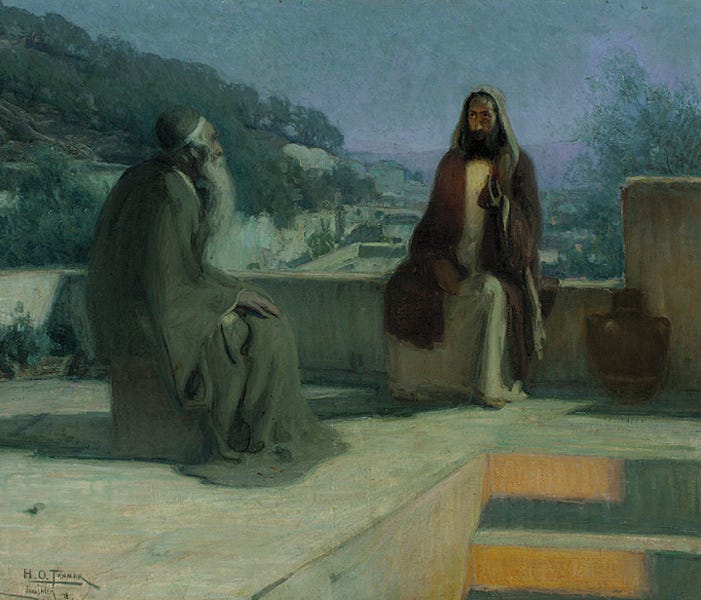
They crucified the Carpenter. During Passover, no less. He was last seen in Jerusalem, causing a stir among the people. They said he was going after the merchants and moneychangers, brandishing a whip and chasing them around like mules. But it was not what He did, but what He said that troubled me deeply: “Destroy this temple, and I will raise it again in three days.”
Let the record show that I was not involved in His brutal punishment. Yes, I was in the Sanderin, but secretly I was doing all that I could to ensure that He was unharmed. I know of one other man from the Council who was a secret disciple of Him. Joseph is his name, and his home is in Arimathea. I cannot begin to imagine the troubles he had to go through to keep this from the rest of us.
I did not know that Joseph was a secret follower until the day they crucified Him. How a carpenter and traveling preacher from Galilee could have met that fate, I fail to understand. But Joseph seemed to have understood. His devotion to the Carpenter was so great, that he even managed to secure a tomb for His final rest.
Even stranger is that Joseph asked me for help with the burial. It was during the night that he came to my home. He asked that I help him carry the body to the tomb, and bring with me seventy five pounds worth of myrrh and aloes for the embalming. All worthy of a king!
Rex Judaeorum. King of the Jews. That was the sentence that the Roman conquerors bestowed upon Him. Our kings build the Temple. This King tried to destroy it.
As I carry the Carpenter King to His tomb, I recall a night just like this, when I paid Him a visit. He was unlike any other teacher of the law that I knew. There was someone similar to him - a man named John who baptized people in the desert. What king Herod did to him, I could not bear to recount.
I knew that some of John’s disciples would follow this Carpenter, and it was through them that I was granted an audience with Him. I had never met Him before, but His reputation was known throughout Judea. They say that at the age of twelve, He sat among the learned rabbis and teachers during the annual Passover visit to Jerusalem, and all were amazed at His understanding of the Law. Not bad for a Galilean.
This was how I greeted Him: “Rabbi, we know that you are a teacher who has come from God. For no one could perform the signs you are doing if God were not with him.” This was not a lie. While other members of the Sanhedrin looked upon Him with disdain, I could not help but be convinced that He was a prophet sent from the Lord.
“Very truly I tell you,” He replied. “no one can see the kingdom of God unless they are born again.”
I could not believe my ears! Born again? How? Surely, He cannot speak about crawling back to our mother’s wombs and being given birth once more?
I told Him exactly this, but He did not miss a beat: “Very truly I tell you, no one can enter the kingdom of God unless they are born of water and the Spirit. Flesh gives birth to flesh, but the Spirit gives birth to spirit.”
At this point, I was convinced that if He was not sent from God, He was the worst case of lunacy ever walked on this Earth. How can anyone, save the angels in Heaven, ever be born without flesh?
“You are Israel’s teacher, and do you not understand these things?” the Carpenter rebuked. “I have spoken to you of earthly things and you do not believe; how then will you believe if I speak of heavenly things?”
What could He mean by “heavenly things”? Who can know what is of Heaven except the Lord?
“No one has ever gone into heaven except the one who came from heaven—the Son of Man.”
I was stunned. The Son of Man? The same He who was revealed to the prophet Daniel? How could a lowly carpenter from Galilee know of the prophecy that even the most learned of teachers are baffled by? And how could He even call Himself with such a title?
I left the audience with the self-identified Son of Man with more questions and confusion. What could His followers see in Him that I could not?
I never met with Him again, until the day of His burial. After what happened to John the baptizer was executed, His disciples did not allow anyone from the Sanhedrin to see Him. But since they had all fled their Master, it was Joseph and I who bore the responsibility of ensuring that He was granted a peaceful death.
As His body was laid to be buried, I suddenly recalled one of the last things He had said before we parted: “For God so loved the world that he gave his one and only Son, that whoever believes in him shall not perish but have eternal life. For God did not send his Son into the world to condemn the world, but to save the world through him.”
Only then, as I stared into the face of this dead Carpenter, could I understand what He meant by being “born again.” When we were given birth from our mother’s womb, we received the gift of life, but not eternal life. The Lord is eternal, but He offers the gift of eternity with Him through the Son of Man, through whom all nations and kingdoms shall be brought back to Him.
Indeed, a grave act of offense to the Lord was committed when they crucified the Carpenter. And I was powerless to spare Him. I deserve condemnation, and so is all of Israel.
But if what He said was true, then through His death, the world might escape condemnation and receive eternal salvation. As I finished His burial, and sealed the tomb, I looked up to the Lord and prayed: “Grant me your ear, O Lord, that this Carpenter whom you sent is truly your beloved Son, and that salvation may come to my house and all of Israel.”
I then turned to Joseph, and asked him if he thought what the Carpenter said might be true. “I cannot know,” said Joseph. “But as the Lord be my witness, I hope so.”
Is this a translated version of something Nicodemus wrote, or more like a fabricated memoir?
I love this. Thanks for posting.